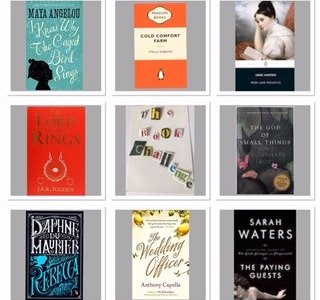
To me a world without books is unimaginable. I could easily cope with no films or television; however, reading is an integral part of my life and always has been. Yesterday, my husband asked me when was it I realised that I love books. I told him that I can’t think of a defining moment as I don’t ever remember not loving reading. In my world there is nothing better than snuggling up and losing track of time, being transported to another world and becoming involved in other people’s lives.
I enjoy my job, working in a secondary school supporting students in English lessons, although it upsets me that many of the kids I talk to and work with don’t like to read. For some, for example those who struggle with dyslexia, this is understandable; though, there are some who simply don’t enjoy it. I believe that technology has a lot to answer for in this case and perhaps, had I been born in this generation with so many more distractions and television channels, who knows things might be different for me.
My older sister, Liz, and I grew up together in the 1970s and were both avid readers. I remember the highlight of birthdays (both in August) and Christmas was receiving a present of £5. This meant that we could afford to buy ten Enid Blyton books at 50p each. I loved going to the book shop. It was like walking into a treasure trove – thrilling – full of potential. I still get excited about the smell of the pages in a new book. You can keep your Kindles – give me physical books – the feel of the pages – the lure of the cover. We must have been extremely easy children because we would go home and read our new books cover to cover like addicts getting a fix and then swap with one another and read the other ten. For me, reading became the best form of escapism.
My own four children were all enthusiastic readers when they were young. I spent years reading bedtime stories of all kinds. It’s easy to look back with nostalgia as a lovely time in my life. It is something I miss now they are all grown up and only one is left at home, although he’s hoping to fly the nest in September if he gets the grades from his teachers that he needs for university – and it’s open! I can also remember the bedtime story being a massive chore at times as the last job of the day after dinner, washing up and bath time when I was a single parent and exhausted.
It is well documented that research has shown how reading with children has a hugely positive impact on them. Apart from equipping them with a wider vocabulary, it creates opportunities to develop imagination and helps them become better writers. Alongside these factors, I hoped it would embed in my children a deep love of reading for the rest of their lives. Sadly, this is not the case. Only one of them, Jack, loves books and reads all the time, although last time I saw Poppy she was reading more than previously. I’m still hoping the seeds I sowed will come to fruition and one day the others will find their love for it rekindled. Perhaps with their own children…
I was nominated by my friend and colleague, Kim, Head of English, to take part in a book challenge on Facebook. To post covers of seven books that I have loved (one book a day for seven days). No reviews, just the seven covers. Each day you nominate a friend to take up the challenge, providing literacy and getting books into the spotlight. We share a love of books and have swapped a few with one another so I was pleased to accept. As other friends were taking part too it was interesting and fun as many of our choices coincided. Choosing seven books is exceptionally difficult and I decided not to overlap with others although I love many of their choices. For this blog I am choosing eight. This is because I nominated my friend, Katie, for the challenge and straight away she put on one of my favourite books and the one I had planned for the following day. We obviously have similar taste. Perhaps this is one of the reasons why we get on so well.
Each book I picked was special to me and took me back to where I was when I read it. So while I enjoyed the challenge and the discussions that followed I was frustrated that I couldn’t talk about why I like the book, or the storyline and the memories it evoked. Yesterday when I was painting my new shed I came up with the idea of writing this to explain why I decided on each book. My first book is:
I Know Why the Caged Bird Sings by Maya Angelou
I came to Maya late in life but have made up for it now and read all her books. She wrote wonderful poetry too. I can never quite decide between Phenomenal Woman as my favourite or Still I Rise. I just watched her perform them on YouTube, amazing! I love the way she sticks two fingers up to the haters. Both poems are wonderful, as is her first novel which narrates her life as she grew up in the deep south of America during segregation. I love her descriptions, her voice and the fact that she’s such a fighter.
As well as coming late to Maya, I came late to education. It was wasted on me in my youth. I was a sickly child. I had whooping cough, measles, German measles and croup. Aged 6 my lungs collapsed; I was rushed into hospital and put on a ventilator in a sterile room like the Covid patients are now. Consequently I spent a lot of time off school at home listening to my parents arguing. As well as being detrimental to me emotionally, it meant I missed the vital building blocks in Maths and other subjects and still really struggle. They eventually divorced when I was around thirteen and I went off the rails. After spiralling into depression and drinking, I became a school refuser and never went back. Therefore I had no formal qualifications until I did some courses as an adult. Having no qualifications has set me back massively in my life as I have always lacked confidence. People with lots of exam results to their name seem to live in another world to me. One where you can be full of confidence and the mentality that anything is possible if you set your mind to it. I have always felt as if I am an imposter and quite often still do.
Fortunately after some disastrous relationships I met my husband, Jason. He has spent twenty years trying to change the attitude that haunts me and thankfully has mostly succeeded. Back in 2010 I was struggling to get a job and got so down that I decided to try and upskill myself and get my Maths G.C.S.E. I went to college and did a preliminary test to ensure I knew the basics and was told that by the lady in charge that I couldn’t, but I could do some beginner Maths classes instead which made me more despondent than ever. She suggested I take the test to see if I could do an English G.C.S.E. When I finished she looked through it and enrolled me there and then. So it was actually a fortunate mistake that drove me to attend night school which opened up a whole new world of academia for me, leading to me going to Exeter College to do an Access course which was where I was introduced to Maya.
Our English teacher, Mark Rawlins was a lovely chap – gentle, calm and kind. We read Maya’s novel in class and I wrote the first essay I was really proud of. When I look back on it I cringe because there are no paragraphs and it sounds like a stream of consciousness. I got so excited I wanted to say everything. Fortunately, he saw the potential in me and gently guided me to writing in a more academic manner. That year I spent at college was one of the best of my life. I made up for the fact that I had my first son when I was aged 17 and missed out on going to university and being young with no responsibilities. Our class was a mish mash of characters. We were all there because we had failed academically and were trying to get to various universities. I was one of the oldest at 40 but they were lovely and because we were all trying to succeed at something it created a wonderful camaraderie.
The best day of the week was Friday as we had English for three hours in the morning. Then we would finish at 12 and go straight down to The Imperial for lunch and drinks. By the time I got the train home at 4 I was often a little the worse for wear. Luckily for me Jason is a kind man and would just laugh and say: ‘I’ve had my time, it’s your turn to have this experience now.’ I made some good friends there, some I’m still in contact with now. I met one of my best friends, Alex, when I went back to college to do a presentation about going to university. I gained so much confidence from going back to education and am so grateful that I did and that I met her because she became my best friend at uni. I was spoiled at college. I thought university would be the same and that other students would be friendly and see past my age. A few did and I knew a couple of people from college but generally it wasn’t a particularly pleasant experience. Exeter University is not a great place to study as a mature student with imposter syndrome. It was a lonely first year where I cried a lot but it taught me resilience. Once Alex arrived in my second year, everything got better. She loves the book too and for my birthday she bought me a beautiful silver necklace with a tiny birdcage and a bird inside as a reminder of how we bonded over Maya – such a thoughtful present and a wonderful novel.
Maya Angelou is a huge inspiration to many people, me included. Although she is no longer with us thankfully we can still watch her perform her poems on YouTube. She also spoke some wonderful words of wisdom which linger on in her quotes…
‘Any book that helps a child to form a habit of reading, to make reading one of his deep and continuing needs, is good for him.’
‘Shakespeare – I was very influenced – still am – by Shakespeare. I couldn’t believe that a white man in the 16th Century could so know my heart.’
When I wrote Love, Life and Lemons I chose one of her quotes about love.
‘Love recognizes no barriers. It jumps hurdles, leaps fences, penetrates walls to arrive at its destination full of hope.’
Day One
Cold Comfort Farm by Stella Gibbons
I chose Cold Comfort Farm by Stella Gibbons although it was a toss- up between this and My Family and Other Animals by Gerald Durrell. They are similar as they both make me laugh out loud. The Durrell family conversations are screamingly funny and the characters in Cold Comfort Farm are fabulous. Also they are both set in the ‘30s, my favourite era alongside the ‘20s. I like the clothes, the music and Flora Poste, the protagonist in Cold Comfort Farm is very appealing and one of my favourite characters. My family constantly accuse me of trying to organise them. I hold my hands up – I feel they need my input – but I’m not a patch on Flora and the way she takes over and organises the Starkadder family. After becoming a penniless orphan as a result of her parents dying from the 1919 Influenza epidemic she rolls up her sleeves determined to foist herself on her unsuspecting relatives. Nothing appears to phase her, as she sets about transforming the farm in Howling in Sussex and its inhabitants. They try to resist but the word no is simply absent from her vocabulary.
Gibbons wrote Cold Comfort Farm as a parody of the romantic and pastoral fiction available at the time. As I live in the countryside I appreciate the characters she created and think she must have done some good research. Perhaps she came to Payhembury? Or perhaps country folk are universal – they are most definitely recognisable. The names of the farm animals reflect her sense of humour. The enormous bull is called ‘Big Business’ and the Jersey herd, his hareem, have equally funny names: ‘Graceless, Aimless, Pointless’ and ‘Feckless’!
I have read some of Stella Gibbons’ other work, a novel called The Matchmaker and some brilliantly written short stories. Both Gibbons and Durrell have an amazing sense of humour. Whenever I read their books they have me chuckling away to myself. At the same time I am in awe as they combine this with beautiful descriptions. They have inspired me as an aspiring writer. Once when I was rereading Cold Comfort Farm in bed I couldn’t stop giggling, so much so that Jason made me read it out loud and soon he was roaring too. Whenever I think of this book I smile, and it cheers me up. I gave my copy away as I wanted to share the joy. I also gave my son, Jack, a collection of her stories.
When I chose this as my first Facebook post my friend, Stephanie, made me laugh as she quoted the famous line: ‘I saw something nasty in the woodshed…’ !
This is another of my favourite quotes from the book:
‘Dawn crept over the Downs like a sinister white animal, followed by the snarling cries of a wind eating its way between the black boughs of the thorns. The wind was the furious voice of this sluggish animal light that was baring the dormers and mullions and scullions of Cold Comfort Farm.’
And about Flora:
‘Like all really strong-minded women, on whom everybody flops, she adored being bossed about. It was so restful’
Stella Gibbons
Day Two
Pride and Prejudice by Jane Austen
This had to be on my list for several reasons. Firstly, I am named after Jane Austen and also Jane Bennett. My sister is named after Elizabeth Bennett. This is because our parents agreed on something which is that they both adore this novel. I think I first read it aged around 13 and couldn’t put it down. It is another novel that makes me laugh and admire the genius way Austen uses dramatic irony. Having read it countless times it reminds me of many different places, people and times in my life…
Aged 17 I was pregnant and had to escape the violent relationship I was in. My mother, having re-married, was in the same situation, so we ran away together to Bath, leaving all our possessions behind except the clothes we were wearing and a carrier bag each. Initially we stayed in a women’s refuge. It was a huge relief to catch our breath and feel safe. Fortunately, we managed to get a bedsit at the top of a steep hill with huge windows overlooking the seven hills that surround Bath. Looking back it was a bit of a dump but to us it felt like a palace. I remember seeing some stunning dramatic sunsets that set the sky on fire and made the buildings built from sandy coloured Bath stone, glow turning them a warm, rosy pink. The workers from the refuge gave us some bedding and other bits and pieces which we carried across town in bin bags. My pregnancy was showing, and the bags were heavy. I have never forgotten that trip because of some guys coming out of a pub looking me up and down and laughing. One of them shouted:
“You shouldn’t have left him should you?”
I’m not going to write my reply but I’m sure you can imagine!
Once we had moved into the bedsit we felt a little less like refugees and grateful to be away from home and the constant fear and feeling of fight or flight. As it’s so long ago I’m finding it hard to relocate those feelings that I have obviously buried deeply in what I imagine as the chest of drawers in my mind with dozens of little drawers filled with memories. I feel like a completely different person now having had a comfortable existence for many years; it is uncomfortable remembering these circumstances. There was a huge family rift and we felt we had no one to turn to. Living in survival mode changed me – I believe that every experience makes you the person you become – and although I’ve buried it I will never forget and be grateful for the life I have now.
We went for lots of walks and explored Bath. It is a beautiful city and despite the circumstances I do have fond memories of living there. People took pity on us and were kind. The landlord was a good man who made the decision to let us stay in one of his bedsits although he said he didn’t normally let to tenants on benefits. The room was square with one wall of windows. It had a double bed, a tabletop oven with one ring on top, a sink, a table and two chairs and a cupboard. There was no wardrobe which didn’t matter as we had hardly any clothes. One of the women who worked at the refuge sent us to the W.R.V.S. hall to get some that had been donated. It was a strange place. A large room filled with clothes on rails which smelt strongly of mothballs. As I didn’t have a coat they gave me a cape. It was one of the most unflattering garments I have ever owned and as it was scarlet I looked like an obese Little Red Riding Hood. Recently, out of the blue my mum reminded me of it saying she could still picture me wearing it. I needed it as it was winter – rainy and cold and we had barely any money. The heating was a one bar electric fire that ran on a hungry 50p meter so had to be rationed. The irony is that living there, when I was at such a low point with nothing, is the only time in my life I have had a cleaner! A lady employed by the landlord would come into the rooms every day and tidy through. We used to clean before she came.
One of the places I enjoyed (and was warm) was the library where I took out Pride and Prejudice. Back in our room we sat huddled under the covers of the bed we shared, and I read it aloud to Mum. Escaping to the world of the Bennetts was an absolute Godsend and gave us solace during a difficult chapter in our lives.
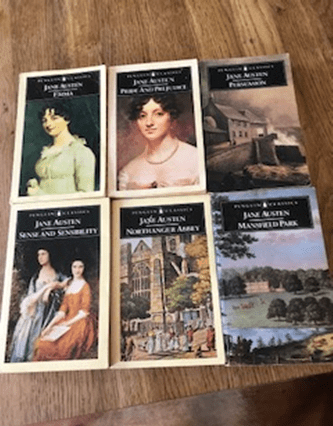
Some years later, aged 23, I ended up in hospital having had a miscarriage. I was feeling down and emotional having just had a blood transfusion when a parcel turned up for me at the hospital. My lovely sister, Liz, had bought me the full set of the six Austen novels which really comforted me and meant I could disappear into the Regency period comforted by Jane. It was a wonderful present and changed my mindset making the stay in hospital bearable.
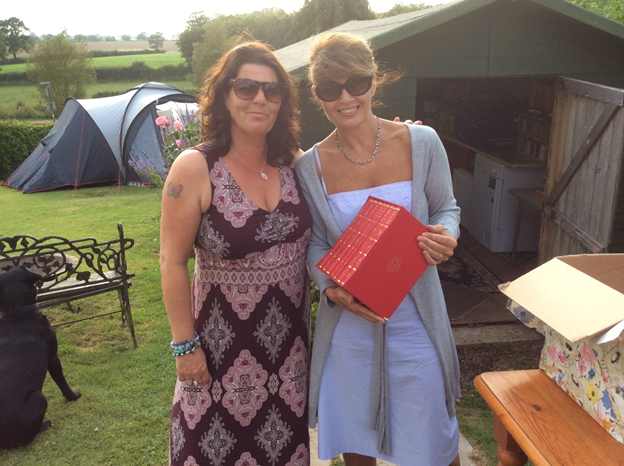
So far these stories related to P&P have been quite depressing, but they aren’t all like that. It was my sister’s 50th birthday a few years ago and we wanted to get her a special present. They had recently moved into a new home and they now have their own library, which I am incredibly jealous of as there are hundreds of books all over the place in my house. As a result there are always libraries in my novels. Liz’s library is gorgeous. Whenever we go and stay I spend time in there enjoying the scent of the books and perusing the shelves. I was thrilled when we went to a second-hand bookshop and I found a beautiful hard back set of the six Austen books in a box. To celebrate my graduation we had a big party. As it was close to her 50th we celebrated that too. It was a gloriously sunny evening. My mum had made bunting we had champagne and tons of wonderful food and gave her the books.
While studying for my English GCSE at night school we read Pride and Prejudice and had to write an essay on an extract from the text. My teacher, Gill, was a lovely woman and she wrote some great things on that essay and gave me an A. Prior to giving it in I was nervous as my writing had never been judged before. It was such an important moment in my life because it was the catalyst that led to me beginning to believe that I could write. Without her encouragement and obvious enjoyment of the text it could have been a quite different experience.
During my Access course I had to write my personal statement explaining why I wanted to study English and History at degree level. Although I can’t remember the exact words Jane Austen made an appearance! I wrote something along the lines that Pride and Prejudice is my favourite novel because without it I would have been unaware that women in the 1800s were capable of having a wicked sense of humour and could use sarcasm to such great effect. She showed me there was a whole subtext beneath the prim and proper exterior we imagine and are told about. History tells us about the economics, the class system and societal expectations, but novels give us a much deeper insight into individual people and their experience of the time and that is why I chose to study them side by side. Perhaps Jane Austen was such a wonderful observer of people because she never married. I like to imagine her sitting in a corner watching and listening to all that was going on around her and squirrelling it away to write in her notebook and use in her novels at a later date.
In my final year at university I studied Austen again. This time all six books plus some of her juvenilia. This was quite a different experience as it delved more deeply into the novels and the politics of the era. Towards the end of the module I had to write a long Austen essay which I was struggling with. This coincided with everyone in my family, apart from me, going away for some reason that I can’t remember now. As I was home alone I sat up until 2 am and watched the whole of the 1995 adaptation of Pride and Prejudice with Colin Firth – which was not a chore! I’ve seen it several times and I don’t think any of the other films that have come after are a patch on it. Thankfully, watching it helped me write the essay. I enjoyed that module and getting more of an insight into Jane’s life. Out of all the books I have chosen if I had to choose just one this would be it. Reading Pride and Prejudice is comfort for the soul.
My friend, Nikki, one of the English teachers, at school has only recently discovered Austen and is reading P&P for the first time. After writing on Facebook that she’s loving it, a friend of hers wrote how wonderful it would be to be experiencing it for the first time, and I felt the same. I’ve no doubt I will read it several more times in my lifetime and never get bored.
Day Three
The Lord of the Rings by J.R.R Tolkien
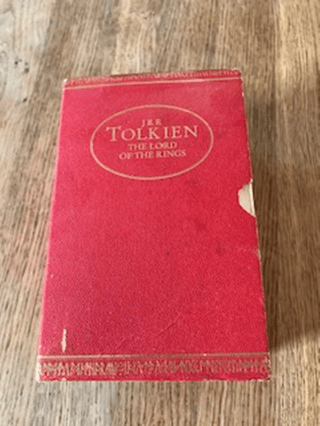
These were bought for me by my father for my 22nd birthday. He was surprised that I asked for them and then pleased when he found out it was the Tolkien centenary in 1992 so he was able to get me this beautiful box set and The Hobbit too.
I first discovered The Lord of the Rings when I was 19. By this time I had my eldest son, Joel, who was a year old, and we were living in the women’s refuge in Exeter. I didn’t have any books so spent a great deal of time in the library and took out The Fellowship of the Ring. Once I began reading – that was it – I was hooked! I was transported to another world and finished it in a few days. I went back to the library, got out The Two Towers and read that at lightning speed too. When I returned it ready to take out The Return of the King I found that the two copies they had were both out on loan already! I kept going back incredibly frustrated and asked if I could book one out as soon as it came back in. They agreed so I went in the day after it was due back and it was late. I was dying to find out what happened. Eventually my patience paid off and I completed the trilogy.
Another reason this is in my top eight is because it’s a family affair. I have fond memories of reading my kids The Hobbit and when The Lord of the Rings films came out all three of my kids were desperate to see it. I am not a film person; I am a book worm. I felt that the director may not have imagined the hobbits and Tolkien’s world in the way I did and refused to go, so Jason took them. Of course they all came back from the cinema raving about it. Next time they persuaded me to go too. I’m pleased they did because I went and fell in love with them. Our family, like many others no doubt, spend a fair amount of time quoting line such as every time someone says the word potatoes: “Potatoes – boil ‘em, mash ‘em, put ‘em in a stew’ ! We all agree that the ending is wrong, and it should show how Hobbiton was infiltrated by evil but obviously, Peter Jackson had to stop somewhere.
When I married Jason back in 2003, Joel was going to walk me down the aisle but he got stage fright when he saw all the guests so Jack stepped in. He was 13 but still quite little. I had a coronet made from roses, pale pink carnations and gypsophila. He took my arm and said ‘Mum you look beautiful, just like Arwen.’ I nearly cried!
When I first met Jason he hadn’t read any of the books so started reading The Hobbit and loved it. He read the others back to back. I’ve heard some people complain about all the songs in them, but I think they are perfect. I do love The Hobbit too (but not the films) and at school recently in a Year 7 lesson we were discussing Quest stories as a precursor to the students writing their own. During that lesson I read them an extract from The Hobbit. It is the bit where they are in the forest and the wolves come. The dwarves, Bilbo and Gandalf are all hiding in the trees it is beautifully written and full of wonderful description. That class are quite chatty and normally easily distracted; however, they all sat enrapt right until the end which shows how engaging Tolkien is as a writer. What pleased me even more was that some of them said they were going to read the book after enjoying the extract.
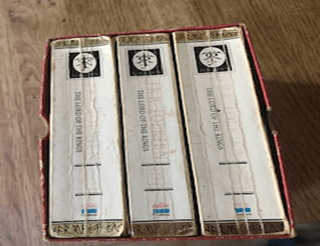
As you can see from this photograph my books are looking a bit battered now but I don’t mind as it shows they are loved.
Day Four
The God of Small Things by Arundhati Roy
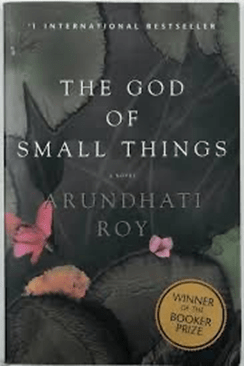
I have read The God of Small Things three times. The first time was when it came out and my mum bought it for me as a present. I enjoyed it although in parts it is heavy going and dark. Arundhati Roy is an inspiring writer I was mesmerised from the opening page and taken straight to India. I felt I was experiencing the stifling heat along with the characters It made me cry and gave me a greater understanding of the effects of the caste system.
During my first year at university we studied it and had to write a long essay. I remember mine not being very good. It was one of the first ones I had written there, and I was struggling with referencing and feeling like an imposter. Fortunately, it didn’t ruin the story for me, and I read it again a few years later as my suggestion for the book club I belonged to. It got a mixed review. Some people enjoyed her brilliant descriptions like I did:
“Dissolute bluebottles hum vacuously in the fruity air Then they stun themselves against clear windowpanes and die, fatly baffled by the sun.”
Obviously, she is not conjuring up pleasant imagery, but that is what I admire about it. Two of my best friends, one who is a writer, said they hated it and found that description pretentious. I disagree.
My son, Jack came back from London during lock down and asked for some reading suggestions. When I gave him this one he lost himself in it reading it in a couple of days. He said he loved it and he learnt a lot too, which made me happy as I love to share good books.
Day Five
Rebecca by Daphne Du Maurier
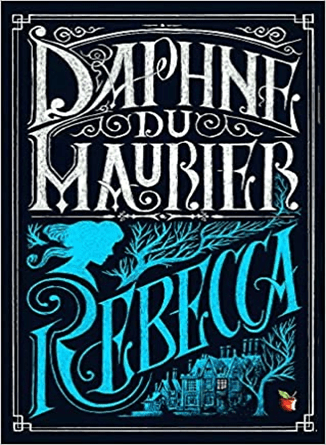
This novel by Daphne Du Maurier was my introduction to the Gothic. I still find Mrs Danvers a frightening character all these years later. I went through a phase of reading Du Maurier books in my teens when I was living in London. As well as providing me with a fondness for gothic writing I also like that they are set in Cornwall. We used to stay there in a caravan when I was little and now that we live in Devon, we often visit. Fortunately, we have friends in our village who have a mobile home on a site in Polzeath; so we have many happy memories of holidays there, as well as Jason and I having our honeymoon making it a special place for us.
Whenever we first see the sea I get a knot of excitement in my stomach. As well as being outstandingly beautiful, Cornwall is edgy with its untamed wildness and history of smuggling. While walking some of the vertiginous coast path the panoramic views are breath taking. Enormous skies blend into the endless sea. I enjoy peering over the edge at tiny coves, only accessible by boat and watching huge crashing breakers battering the rocks below. The Cornish currents are dangerous, and I have a healthy respect for them stemming from being young and reading one of my favourite Enid Blyton books, Malory Towers, about a boarding school. A girl called Amanda, described as “a strapping athlete” is a strong swimmer who plans to enter the Olympic Games. It is forbidden to swim in the sea from the school because of the treacherous current and sharp rocks. She decides the pool is too small and makes a secret plan to swim far out to sea before anyone else gets up. Pride comes before a fall in Enid Blyton books.
“Amanda felt the strong, swift current beneath her. How could she ever have laughed at it? It was stronger than ten swimmers, than twenty swimmers. It pulled at her relentlessly, and no matter how she swam against it, it swept her in the opposite direction.”
She gets washed away by the current and gashes her arm and tears the muscles in her legs on the rocks before she is rescued meaning she can’t swim again for the whole rest of the summer.
My favourite memory of reading Rebecca is the second time when I was lying on the beach at Polzeath – not long after we had Will – so around eighteen years ago. He was asleep under the parasol and Jason had taken the other three off on the long walk to the sea to body board. Lying there on my lounger with the sun caressing my skin and a whisper of wind keeping me cool. I could hear the distant roar of the waves and children laughing as they built sandcastles. As Will was tiny I was exhausted with night feeds, so it was bliss to have some peace. I remember opening the book, reading the iconic opening line,
“Last night I dreamt I went to Manderley again.” and losing myself. Like Cold Comfort Farm, this is set in the 1930s. I have always been fascinated by this era and the idea that some young women had to become a companion to someone awful in order to have the opportunity to live in hotels and get to travel abroad. I guess as an orphan, the protagonist didn’t have many options but was impetuously marrying Max de Winter, who she knew for 5 minutes, a better one?
After giving this novel to Auriol, my son, Jack’s girlfriend, we discussed it and she said found it hard to like the un-named narrator – the second Mrs de Winter. I think she thought she was a bit pathetic. I had to agree that she is not a feminist. The story wouldn’t have worked if she wasn’t meek and mild, she doesn’t even have a name! However, I like her and feel an affinity with her because she feels like she doesn’t fit in. She has imposter syndrome and is fighting a psychological battle.
The Hitchcock film version is wonderful and so creepy, full of pathetic fallacy and intrigue. I’ll never forget the scene at the party when the new wife comes downstairs dressed like Rebecca , or where Mrs Danvers is trying to persuade the new wife to jump out of the window telling her she’ll never match up to Rebecca. Also, the setting is amazing – the gorgeous house with the garden leading down to the sea – and the ending when it’s on fire is so dramatic.
Writing this makes me realise how much I miss Cornwall and can’t wait to visit again soon.
Day Six
The Wedding Officer
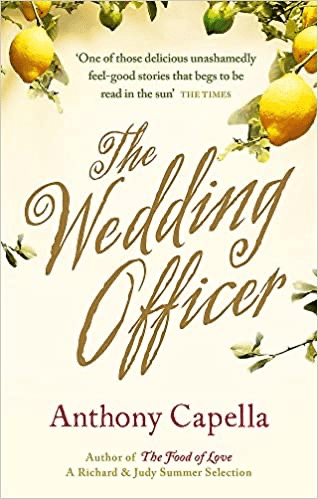
This book has a special place in my heart as it hugely inspired my own novel, Love, Life and Lemons. The Wedding Officer is set during World War Two and is a love story between Italian Livia, who initially lives in a farm on the slopes of Mount Vesuvius, and English James, who is the Wedding Officer. He has been posted in Naples to stop all the weddings between the English soldiers and their Italian girlfriends. It is 1943, the Italians are starving, and these women are desperate for a way out. James is straight laced, very British – stiff upper lipped- and settled in his ways preferring potatoes to pasta. He has no understanding of, or love for food until Livia, his feisty Italian cook, educates him and seduces him. Ironically, for a man who would never dream of flouting the rules he finds himself in love…
My book is like this one, in the way that cultures clash as Margaret, an English woman, and Corrado, an Italian, fall for one another. However it is Corrado who uses lemons and his cooking to seduce Margaret. Capella’s character is based on a real person. While visiting Naples, he took along the memoirs of a British soldier whose role was to stop the sudden rise in wedding licences being requested. My novel is based on my Grandmother, Margaret and some of her experiences. Both books are full of food, particularly lemons and mozzarella and make the reader hungry. Livia has some buffalo at home on her farm near the mountain. Her favourite is the naughty one, Pupetta, who is always poking her head through the window and stealing things. There are buffalo in my book too and the cheeky one, Carlos, whose favourite pastime is getting into the veg patch and munching away, ends up in England at Corrado’s farm.
I have read this novel several times and I would definitely recommend it. Although not a highbrow read, it is entertaining and laugh out loud funny. I took it with us when we went on our first holiday to Italy in 2015. We stayed in a beautiful villa in Tuscany, with a swimming pool, near Lake Bolsena. It was the perfect setting. I laid on a sun lounger by the pool with a glass of wine and read about the delicious dishes Livia serves up and then in the evenings we ate similar local delights – creamy mozzarella with juicy ruby red tomatoes that tasted of the sun topped off with fragrant, torn basil leaves. I drank in all the sights, sounds and smells I experienced and wrote them in my notebook along with the food we ate. Back at home I used my research to bring my story to life.
I am incredibly lucky to have visited Italy a few times now. I’ve been to Bergamo, near Milan, in the north which was amazing, and Rome and Tuscany, in the middle of the country. The last place we went was Salerno, near the Amalfi Coast right down south. Driving past Mount Vesuvius brought this book back to me and Jason. We talked about it for ages remembering snippets and laughing as he loves it just as much as me. Seeing the volcano in real life was awe inspiring. Huge – it rears up dominating the skyline – smoking malevolently and everyone just goes about their daily business ignoring it like the elephant in the room! Much as I love Italy I would not want to live under that monstrous shadow; however, 3,000,000 people do. After doing some research I found that more people live near Vesuvius than any other volcano in the world. It has erupted around 50 times and at the end of The Wedding Officer it plays a big part.
My chef son, Jack was telling me that some fantastic food comes from that region. Apart from the best lemons in the world there is a variety of tomato ‘Pomodorino del Piennolo del Vesuvio’. Also grapes grown there make special wine called ‘Lacryma Christi’ as the volcanic soil is uniquely fertile. My new book is set in the Amalfi region; so I am enjoying researching the different foods grown in the area to add in as there is a story about a chef…
Day Seven
The Paying Guests by Sarah Waters
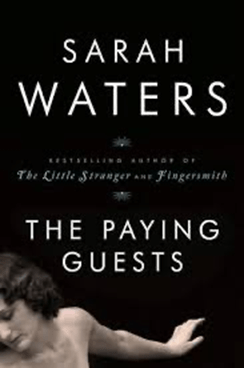
I delight in everything by Sarah Waters because her writing is mesmerising. She is brilliant at graphic descriptions and particularly good at setting scenes. This novel explores the class system post World War One, where so many men had died. It is a time of social transition and the protagonist, Frances, finds herself socially displaced as her father’s death leaves her and her mother with a large house but no money. They have to resort to taking in lodgers – a working class couple – the Barbers who turn Frances’ staid world upside down.
Each book I read, I regard as a study to learn from and improve my writing as I am constantly practising and striving to write more descriptively, with better plots, speech and characterisation. Reading Waters never disappoints. I always learn something. As well as being brilliantly written, I found this novel set in 1922 useful as research for my own book which is set only a few years later. Frances is a feminist and a likable character. As many of Sarah Waters’ books, the story explores forbidden love – the two women fall for one another and have wild sex – before the story takes a different trajectory halfway and becomes a thriller, full of suspense. I can remember it drawing me back to it making me wonder about the plot and the characters while on a dog walk. I couldn’t wait to get home and read more. Fortunately, it was the summer holidays so, although 500 pages long, I finished it in two days.
If you’ve read this far well done (as it’s so long) and thank you for coming on my book journey with me. If anyone has any good book suggestions please feel free to leave me a message on my website.


Wonderful descriptions of your favourite books with your personal parallel stories adding an evocative extra dimension too …
LikeLike